


For centuries, humans have dreamed of conquering the skies and, eventually, the boundless expanse of space. What once seemed like mere science fiction has ultimately become reality. Spaceflight is one of humanity’s most significant achievements, opening up new frontiers for science, technology, and future generations. Since few people will ever get to travel to space, what can the rest of us do to experience that atmosphere and feel like we’re part of it? The answer is simple. Directors bring these desires to life, giving viewers a realistic picture of being aboard a spacecraft or on another planet alongside movie and series characters. Two of the most popular and realistic space films, both of which were filmed in Houston, are “The Martian” and “Apollo 13”. We explore this on houston-trend.
Quick Synopses
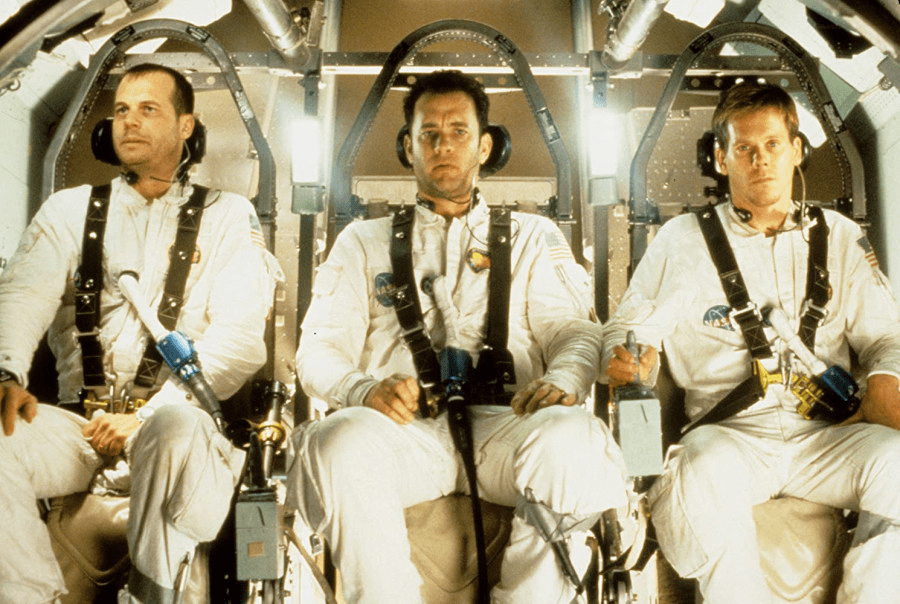
“Apollo 13,” released in 1995, is based on the real-life 1970 NASA mission of the same name. It was the only Apollo series spacecraft to suffer a major failure during its flight to the Moon. The film is based on the book “Lost Moon: The Perilous Voyage of Apollo 13,” written by crew member Jim Lovell and journalist Jeffrey Kluger.
Astronauts Jim Lovell, Fred Haise, and Jack Swigert are en route to the Moon when an oxygen tank explodes, causing critical damage to the spacecraft. The mission is aborted, and the crew must fight desperately for survival. Meanwhile, back in Houston, NASA’s Mission Control Center, led by Flight Director Gene Kranz, scrambles to devise a special rescue plan to bring the astronauts home. Limited resources and a shortage of oxygen force the main characters to face numerous challenges. However, thanks to NASA’s ingenuity and the crew’s extraordinary resilience, the Apollo 13 spacecraft successfully splashes down in the Pacific Ocean. The film is also famous for the legendary line: “Houston, we have a problem,” which people now use to describe any unexpected issue.
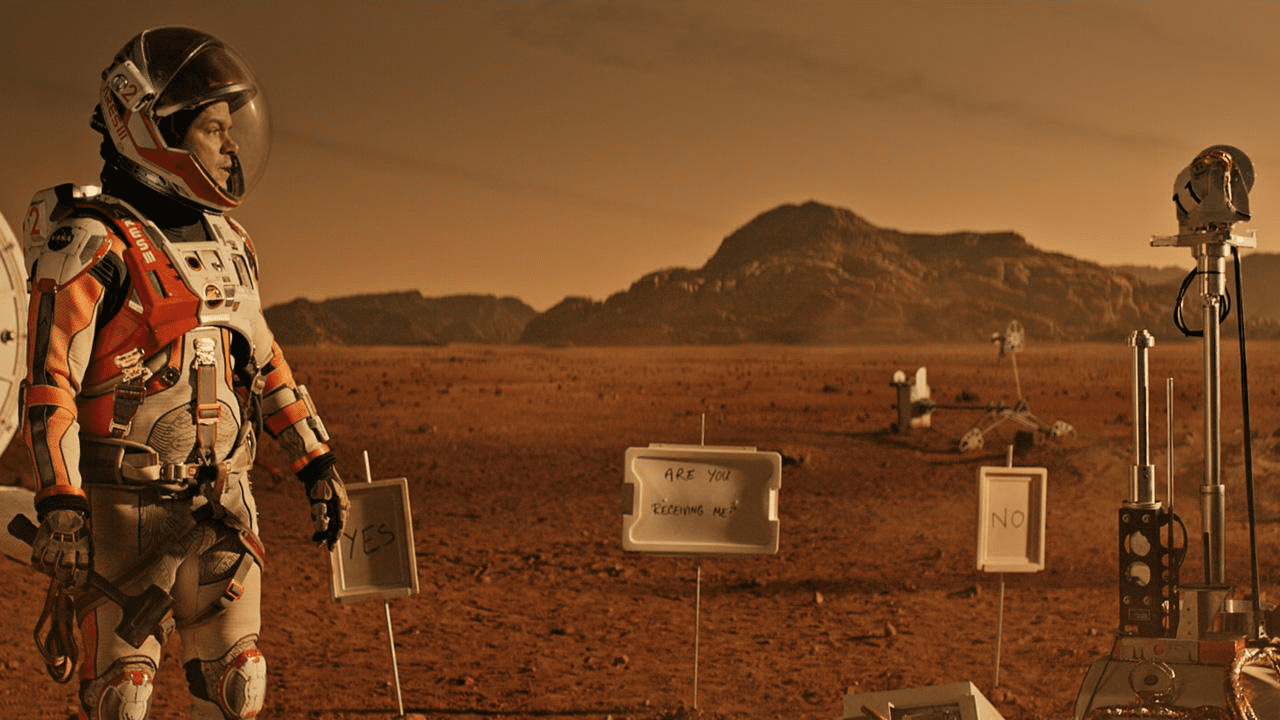
“The Martian,” released in 2015, is based on the novel by Andy Weir. Here, the situation is somewhat different from the previous film. During the Ares 3 mission to Mars, a severe storm forces the entire crew to evacuate the planet, but one astronaut is left behind. Mark Watney is presumed dead by his crew, but he miraculously survives and finds himself stranded alone on a hostile planet with no way to communicate with Earth. Nevertheless, Watney refuses to give up. He uses his scientific knowledge and ingenuity to survive by growing potatoes in Martian soil and desperately trying to re-establish contact.
When NASA learns the astronaut is alive, they begin developing a rescue plan at the Mission Control Center in Houston. After many risky decisions and setbacks, the Ares 3 crew returns to Mars to save Mark. The astronaut successfully leaves the planet, proving that human resilience and teamwork can overcome any difficulty.
The Houston Connection
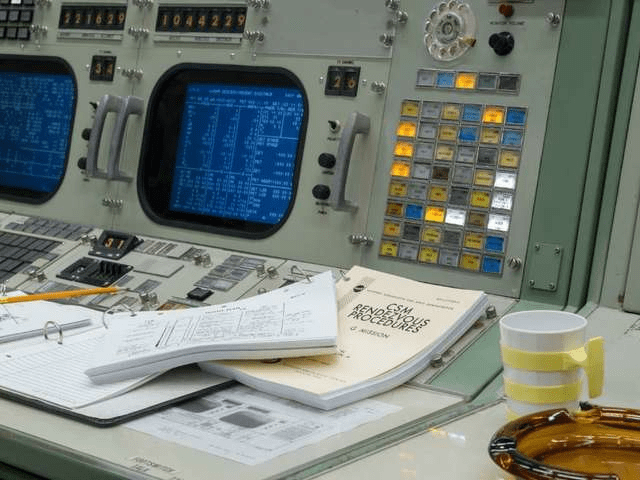
Both space films were shot in Houston at the Lyndon B. Johnson Space Center (JSC). This setting allowed the filmmakers to capture the authentic NASA atmosphere. The lead actors trained with actual astronauts, and for maximum realism, some scenes were filmed inside Houston’s Mission Control Center, which was able to convey all the tension and complexity of the organization’s work.
Beyond the filming locations, Houston is the historic site where the planning, preparation, and management for all the real Apollo missions took place. It was here that specialists worked tirelessly to rescue the Apollo 13 crew following the film’s most famous line: “Houston, we have a problem.”
The strong connection to the city after the release of both films generated high interest among tourists and journalists, sparking renewed public interest in space missions and Mars exploration. “The Martian,” in particular, helped popularize the Artemis program and plans to land humans on Mars. Both movies underscore the importance of Houston as the nerve center for making key decisions in critical space situations.
Similarities and Differences
Both movies are thrilling stories about space missions that encounter severe problems. However, they share both common threads and distinct differences.
Foremost, both films feature the theme of survival in space, where the protagonists find themselves in deadly situations and are forced to fight for their lives. Also, in both pictures, the NASA Mission Control Center in Houston is the central location for making crucial decisions about rescuing the heroes. Furthermore, both films emphasize the vital importance of teamwork, upon which their collective survival and return home depend.
It’s important to note that “Apollo 13” depicts a real event that happened in 1970, while “The Martian” is a fictional story. The core problem in each film is completely different: in the first, it’s an oxygen tank explosion leading to critical shortages of energy, oxygen, and water; in the second, it’s an astronaut stranded alone on Mars without resources or communication with Earth.
The most important shared trait is not just that the events unfold in space, but the ending. Fortunately, in both films, all astronauts are successfully rescued from their critical situations and return to their home planet.
Accolades
Both films successfully burst onto the cinematic scene and earned their deserved awards. “Apollo 13” received nine Oscar nominations in 1996 and won two: Best Film Editing and Best Sound. Director Ron Howard won the Golden Globe for Best Director. The film also won Best Editing at the BAFTA Awards.
“The Martian” received seven Oscar nominations in 2016 but did not win any. However, it did win the Golden Globe for Best Motion Picture – Musical or Comedy and Best Actor for Matt Damon.
Both films were critically acclaimed for their realism, acting, and technical execution, making a significant contribution to space-themed cinema.

“Apollo 13” (1995) and “The Martian” (2015) are shining examples of scientific space cinema that not only captivate audiences but also illustrate the real difficulties astronauts face. They help viewers who may not understand the science to grasp the intricacies and risks involved in space exploration.
Despite the shared theme of survival in space, the films take different approaches to storytelling. “Apollo 13” is a serious historical drama that recreates a real 1970 NASA mission, utilizing documentary accuracy and minimal artistic license. Conversely, while “The Martian” is founded on scientific facts, it is a fictional story that blends drama with elements of humor. This makes it easier to digest, despite the gravity of the main character’s situation.
Both films received high critical praise and numerous awards, and both prove that space is not only about the romance of exploration but also about serious challenges that demand maximum concentration, knowledge, and the coordinated work of thousands of people. They show that the success of space missions depends not only on the astronauts themselves but also on the ground crews at NASA, working out of the Mission Control Center in Houston. These films don’t just entertain—they motivate audiences to consider the role of science, engineering, and technology in exploring the universe, inspiring new generations to look toward the cosmos.